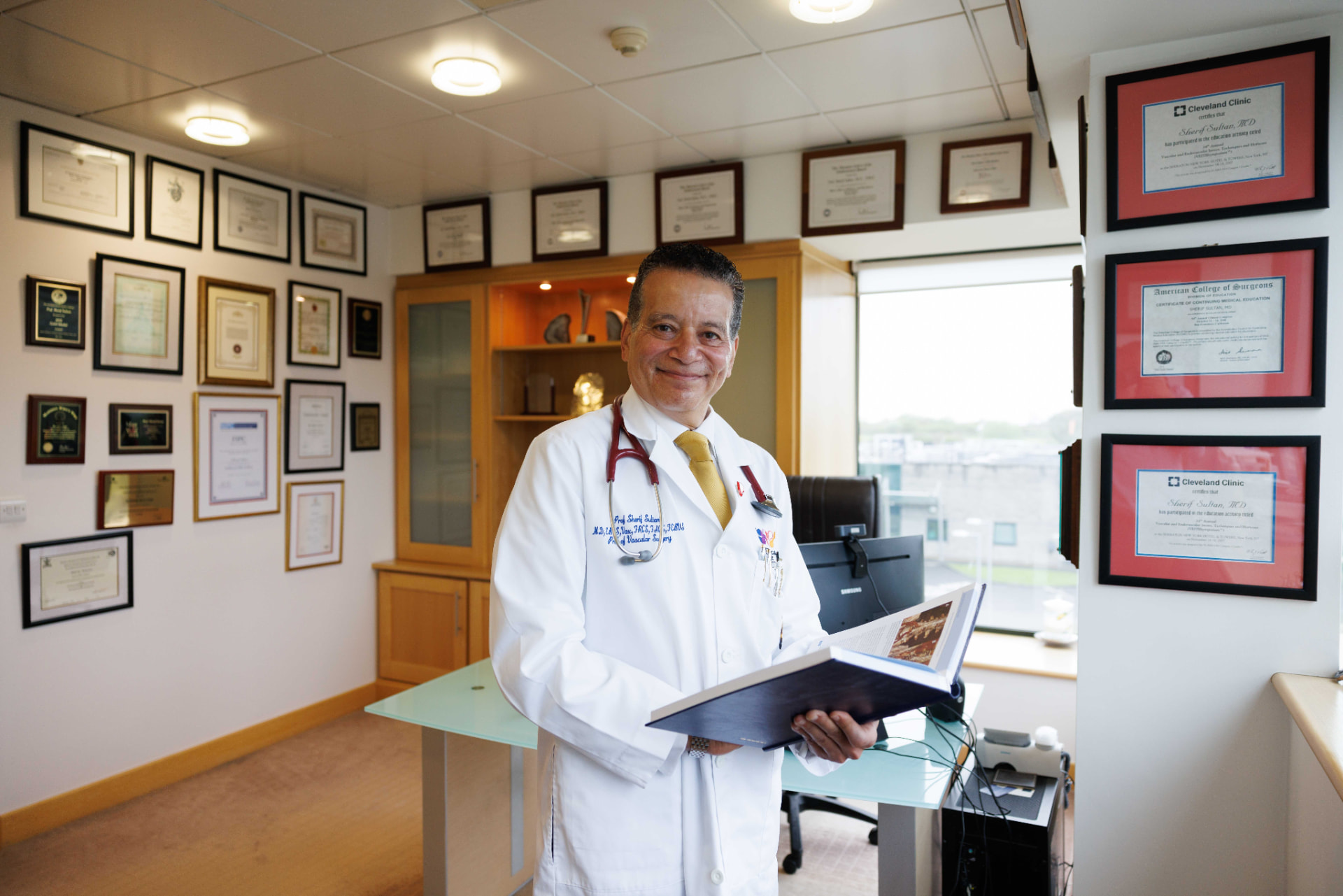
Professor Sherif Sultan in his Galway Clinic office, wearing a white coat and holding an open book
Galway Clinic · Consultant vascular and endovascular surgeon
in vascular surgery
40 yrs
patients cared for
10,000+
patients seen each year
500+
screening appointment
15 min

Surgeon · Teacher · Inventor

Professor Sherif Sultan

Professor Sherif Sultan brings four decades of experience in vascular and endovascular surgery, and is internationally recognised for pioneering both open and minimally invasive techniques.

A career built around preventing strokes, amputations and ruptured aneurysms

Prof Sultan is Chief of Vascular and Endovascular Surgery at the Galway Clinic and the senior vascular surgeon for the Saolta University Health Care Group, having previously served as its Clinical Vascular Lead. Together with its teaching hospital, the Galway Clinic, the group comprises eight hospitals serving over 1.5 million people.

He leads a team of vascular specialists dedicated to reducing cardiovascular death and disability — catching disease early, treating it with the least invasive method that will work, and keeping people out of hospital and on their feet.

He specialises in stroke prevention through same-day carotid artery intervention; endovascular, open and hybrid repair of thoracic and abdominal aortic aneurysms and dissections; lower-limb revascularisation and limb salvage in critical ischaemia; visceral and mesenteric revascularisation; and wound care for chronic venous ulcers, including hyperbaric medicine. Varicose vein surgery is carried out as a minimally invasive four-hour admission.
Professional standing

Leadership and standing

  • Professor of Vascular and Endovascular Surgery, University of Galway
  • Chief of Vascular and Endovascular Surgery, Galway Clinic
  • Founder and Chairman of the Western Vascular Institute, a charitable research and education foundation
  • President of the International Society for Vascular Surgery, elected in November 2016
  • Dean, International Endovascular Fellowship, University Hospital Galway and the Galway Clinic
  • President of the American Society of Angiology, Irish chapter
  • Distinguished Fellow of the American College of Surgeons and Fellow of the Society for Vascular Surgery

Chapter 01

Techniques he has pioneered

Prof Sultan has developed and established a series of techniques now used in vascular practice: sub-intimal angioplasty; the DRESS technique for complex EVAR; the kinetic elephant trunk for pan-aortic dissection; the TIGER protocol for infra-diaphragmatic aortic dissection; and the PASHA and ARAFAT techniques for concealed endoleak and aortic sac hygroma.

His innovations also include triple neuroprotection for acute vascular stroke beyond 24 hours, TCAR and PerCAS for cervical carotid stenting, the hyperbaric medicine box for refractory venous ulceration, coeliac sympathectomy for median arcuate ligament syndrome, anterior scalenectomy for neurogenic thoracic outlet syndrome, ArtAssist capillary bed recruitment for critical limb ischaemia, and deep venous arterialisation for limb salvage in patients with no other option.

He has produced level-one evidence for the management of arch aneurysm, aortic dissection, thoracic aortic pathology and refractory venous ulceration, and originated the concepts of Vasc-Omics, cardiovascular neurocristopathy and digital twin technology using wireless e-medical tattoos.

Chapter 02

Research and invention

Prof Sultan leads a research team of PhD students, post-doctoral researchers and clinical fellows at the Western Vascular Institute, the University of Galway, the CORRIB-CURAM-Vascular Group and Atlantic Technological University, funded by the European Commission, the Irish Research Council, the Health Research Board, Science Foundation Ireland and industry partners.

His research includes over 245 peer-reviewed articles, 307 abstracts, two books, sixteen book chapters and more than 650 presentations at national and international meetings, recognised with 36 international awards. The US National Institutes of Health cited his publication on the cost-effectiveness of endovascular aortic repair as one of the most groundbreaking in the field in the past decade. Google Scholar records 17,579 citations since 2016, an H-index of 39 and an i10-index of 136.

He holds seventeen patents. Enterprise Ireland awarded him a commercialisation fund in 2016 to develop an endovascular cervical access system for stroke management, he won the MedX international accelerator innovation competition in 2021, received the Cleveland Clinic and Enterprise Ireland Clinical Innovation Award in 2013 for his stem cell delivery catheter, and in 2007 won InterTradeIreland's Equity Network award for Best International Emerging Company for an endovenous varicose vein ablation device.

Chapter 03

Precision and computational medicine

In recent years his group has expanded into precision and computational medicine: characterisation of cardiovascular neurocristopathy, machine learning for image segmentation and predictive modelling of vascular service demand, the gut microbiome as a biomarker in aortic disease, and artificial intelligence for prognosis in acute aortic syndrome and aneurysm.

He is a standing member of international multispecialty consensus groups on carotid disease and has co-authored Cochrane systematic reviews on thoracoabdominal and aortic arch pathology, cervical artery dissection, mobile health technology in intermittent claudication and dietary interventions in cardiovascular prevention. In 2025 his randomised controlled trial of bridge negative-pressure wound therapy with compression established level-one evidence for managing non-healing venous ulcers.

Chapter 04

Training and qualifications

Prof Sultan qualified in medicine at Ain Shams University in Cairo in 1987, winning the Gold Medal in Surgery, and completed a master's degree in surgery in 1991 and a doctorate in surgery in 1995. He was awarded his FRCS in Dublin in 1995, followed by an endovascular fellowship at the Phoenix Heart Institute in Arizona and a Diploma in Endovascular Surgery from the University of Paris XII.

He achieved his Intercollegiate FRCS in vascular surgery in London in 2001 and the Gold Medal in the European Board of Vascular Surgery examination in Lucerne the same year, then settled in Galway to build the region's vascular service. The Lucian Blaga University of Sibiu conferred a Doctor Honoris Causa in 2015, and he completed an advanced leadership programme with San Telmo International Institute, Harvard Business School and the Timoney Leadership Institute in 2017.

Chapter 05

Teaching and the next generation

In 2007 Prof Sultan established the endovascular master's programme with the University of Galway, and he is Dean of the International Endovascular Fellowship. He has built Irish Research Council and European-funded PhD programmes with biomedical engineering partners at the University of Galway, Trinity College Dublin and Atlantic Technological University, using 4D and diffusion tensor MRI, tissue testing and computational analytics to study aortic and carotid disease.

He was an early adopter of virtual and augmented reality simulators for training cardiovascular interventionalists, and his group builds patient-specific simulations and cloud-based eLearning tools accessible anywhere in the world.

Chapter 06

How he works with patients

Patients consistently describe a surgeon who explains things plainly, without rushing and without jargon. Every consultation covers what the scan showed, what the options are, what each one involves, and what happens if you choose to do nothing for now.

You are welcome to bring a family member with you, to ask for a second opinion, and to take time over your decision.

Associations & Hospitals

Professional associations and hospitals Professor Sultan works with

Logos of the Western Vascular Institute, Galway Clinic, European Society for Vascular Surgery, International Society of Endovascular Specialists, Vascular and Endovascular Surgery Society, Royal College of Surgeons in Ireland, Saolta University Health Care Group, Society for Vascular Surgery, Galway University Hospitals, Vascular Society, and NUI Galway